The Seduction of the Sweep
There's something about a mechanical watch that gets under your skin. I remember the first time I really looked at one — not glanced at for the time, but looked at it. The seconds hand didn't tick. It swept.
Most watches you've owned are probably quartz — a battery sends current through a tiny quartz crystal, which vibrates at a precise frequency, and that's what moves the hands. One tick per second. It's accurate and cheap and it's how the vast majority of watches work. A mechanical watch has no battery at all. It runs on a mainspring — a coiled strip of metal that slowly unwinds, releasing energy through a series of gears and a balance wheel that oscillates several times a second. That's why the seconds hand sweeps instead of ticking: it's making six or eight tiny steps per second instead of one. The whole mechanism is powered by nothing but physics and craftsmanship, doing what it's done for centuries. Mechanical watches come in two varieties: manual wind, where you wind the mainspring yourself by turning the crown, and automatic, where a small rotor spins with the motion of your wrist and winds it for you.
I was hooked. I started reading forums, learning the language — movements and complications, bezels and calibers. I wanted chronographs with their subdials and pushers. I wanted exhibition casebacks so I could watch the rotor spin. I wanted moonphase displays and power reserve indicators. The more a watch did, the more I wanted it. There was an almost philosophical appeal to it: here was a machine that kept time through pure mechanical ingenuity, and I was carrying it on my wrist.
Quartz? Please. A battery-powered watch felt like cheating. Like hanging a print when you could have the painting. I would have told you that a quartz watch had no soul.
The Weight of Enthusiasm
Not all mechanical watches are heavy. A hand-wound dress watch can be nearly as slim as anything quartz. But the ones I was drawn to — the automatics, the chronographs — those were substantial. And I wanted them on steel bracelets.
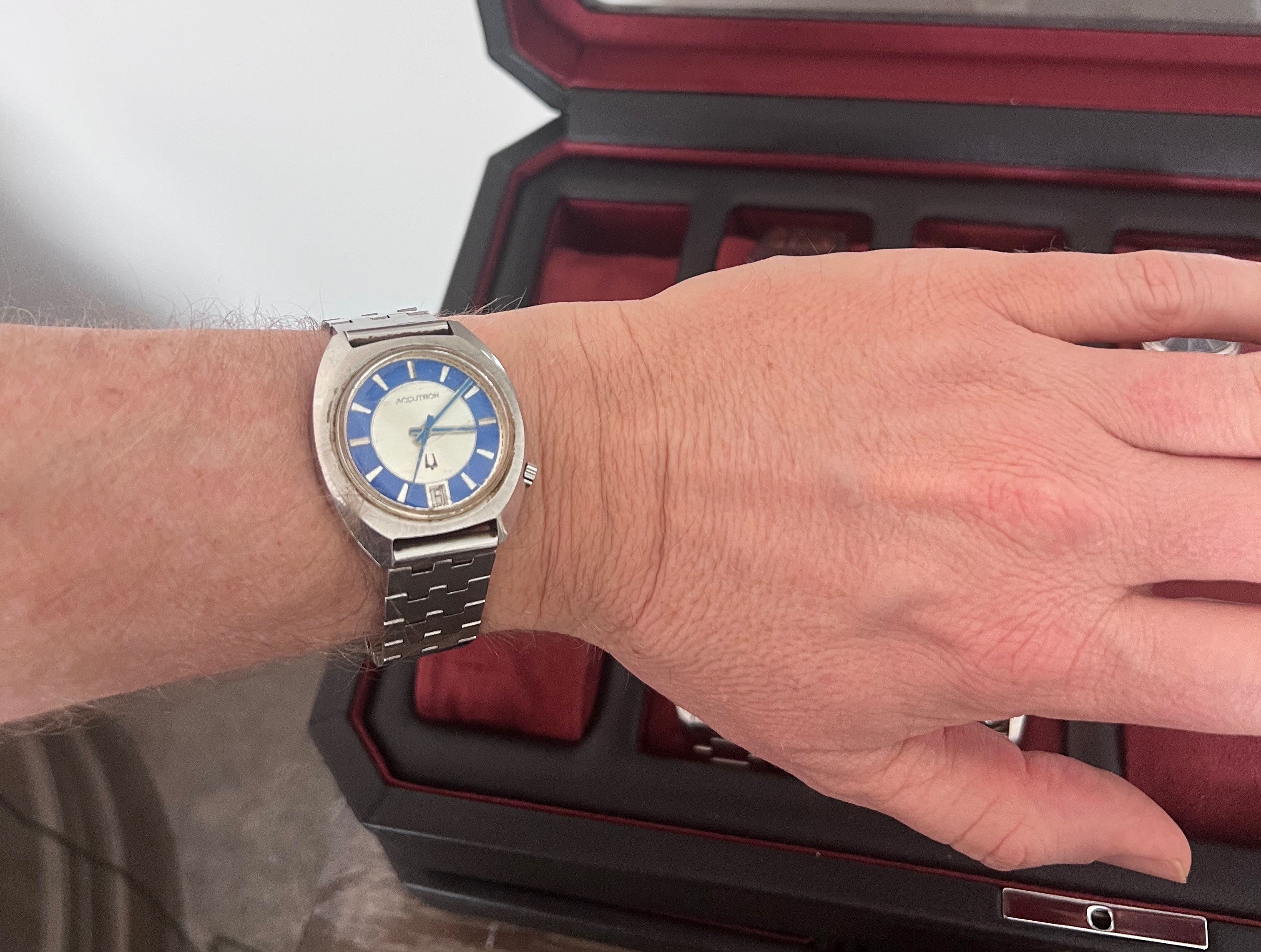
I know where that came from. In 1975, my mom put a Bulova Accutron on layaway so she could give it to my dad for Christmas. Stainless steel case, steel bracelet. He wore it every day for the rest of his life — eighteen years, until he died in 1994. That watch was on his wrist for nearly the entire duration of my time with him on this earth.
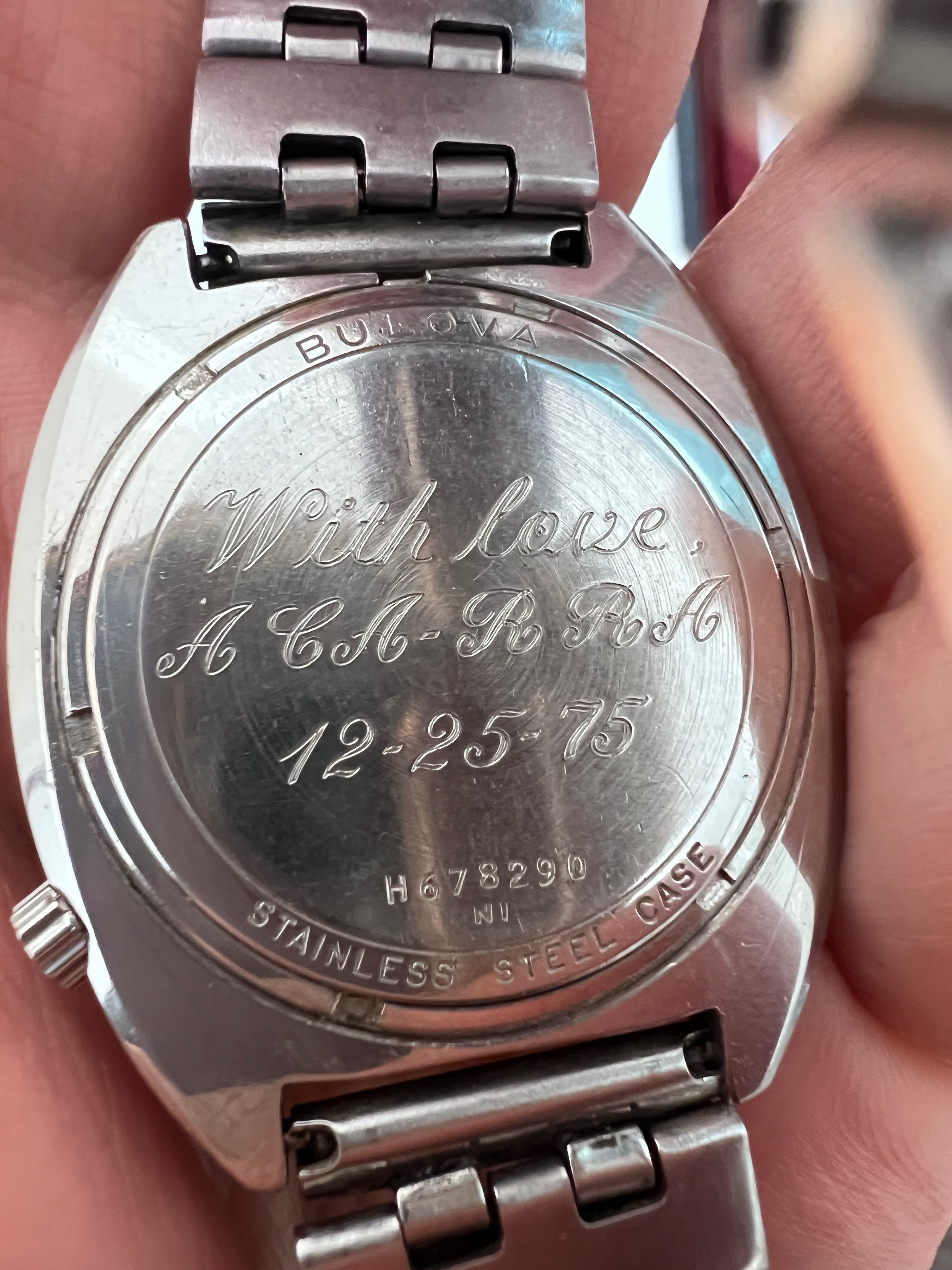
Ironically, the Accutron was a quartz — one of the first, novel enough at the time that my mom had to save up for it. The Accutron name actually goes back to 1960, when Bulova released something stranger: a pre-quartz electronic watch that kept time with a transistor-powered tuning fork instead of a vibrating crystal. But that's a story for another post. The point is it wasn't mechanical, and I didn't care. I didn't think about the movement. I thought about the bracelet. The way it caught the light on his forearm. The way it meant he was my dad, and he was a man, and he was there.
So when I started buying watches of my own, steel bracelets weren't really a style choice. They were something closer to an inheritance. If you wore a watch on a steel bracelet, you had arrived at something — solidity, permanence, the kind of quiet durability I associated with him. I think a lot of men carry some version of this, whether they trace it back to a father or not.
The funny thing is that the Accutron itself was a modest watch. Well under 38 millimeters, probably closer to 35. The bracelet was thin — fine links, maybe hollow, light enough that it draped on his wrist rather than clamped it. The watch I was romanticizing was actually a small, light, unassuming thing. But the bracelets I went looking for were not. I wanted the chunky oyster-style links, the solid end links, the heft. I was chasing the feeling of that watch, not the watch itself.
The reality on my 6.25-inch wrist was less romantic. A chronograph with a heavy steel bracelet is a significant presence. I'd find myself adjusting it throughout the day, rotating it back to center after it slid around. The case height meant it caught on shirt cuffs. I learned to angle my wrist a certain way getting dressed. At some point I started swapping the bracelets for nato straps, then leather, then sailcloth — lighter materials that sat better on a smaller wrist. And the industry has been drifting that way too, if you look for it — beads of rice bracelets, finer link patterns, thinner profiles. Something closer, actually, to what my dad's Accutron had all along. Which should have told me something about what I actually wanted, but I wasn't listening yet.
And then there's the accuracy question. A good automatic might gain or lose five to ten seconds a day. That doesn't sound like much until you realize you're resetting it every week or two. If you own more than one and rotate them, you're resetting and winding them, because they've stopped while sitting in the drawer. I bought a watch winder, which is essentially a small motorized box that mimics wrist movement to keep an automatic running when you're not wearing it. I want you to sit with that for a moment: I bought a machine to wear my watch for me when I wasn't wearing it.
The hobby started to feel less like appreciation and more like maintenance.
Dropping the Gate
The shift wasn't away from mechanical watches. I still like them. I still own them. There's something grounding about winding a watch every morning — a small analog ritual to hang onto in a world that's mostly screens and notifications. You feel the mainspring tighten under your fingers and you know something physical is happening, something with a direct relationship between your effort and the result. I don't want to give that up.
What I've given up is the snobbery.
I used to look at quartz the way a vinyl collector looks at Spotify — technically fine, maybe even superior in some measurable way, but missing the point. The craft, the heritage, the soul. And there's a whole culture in the watch world that reinforces this. Mechanical movements are revered. Quartz is tolerated. You're supposed to appreciate the hundreds of tiny parts, the hand-finishing, the artisanal tradition.
But how much of that is real? The movements in most mechanical watches I've owned weren't assembled by a watchmaker hunched over a bench with a loupe. They were produced in factories, same as everything else. Miyota, Seagull, Sellita — these are industrial operations. The romance of the handmade is mostly marketing, at least at the price points where most of us are shopping. I was paying a premium for the idea of craft, not necessarily the reality of it.
Meanwhile, I was dismissing quartz movements that are more accurate, more durable, and more affordable. A Citizen Eco-Drive charges from any light source and holds that charge for months. Accuracy within fifteen seconds per month. No battery changes, no winding, no watch winder humming on your nightstand. And it costs what I used to spend on a single steel bracelet.
I started reaching for the thinner watches. The ones that slid under a cuff without snagging. I noticed I was checking the time more easily on cleaner dials — fewer subdials, higher contrast, a day-date at a glance. The chronograph pushers I once coveted were buttons I never actually pressed. When was the last time I timed anything? I have a phone for that. I have a phone for all of that, really, which is a separate existential question for watch people that I'll set aside.
The Field Watch
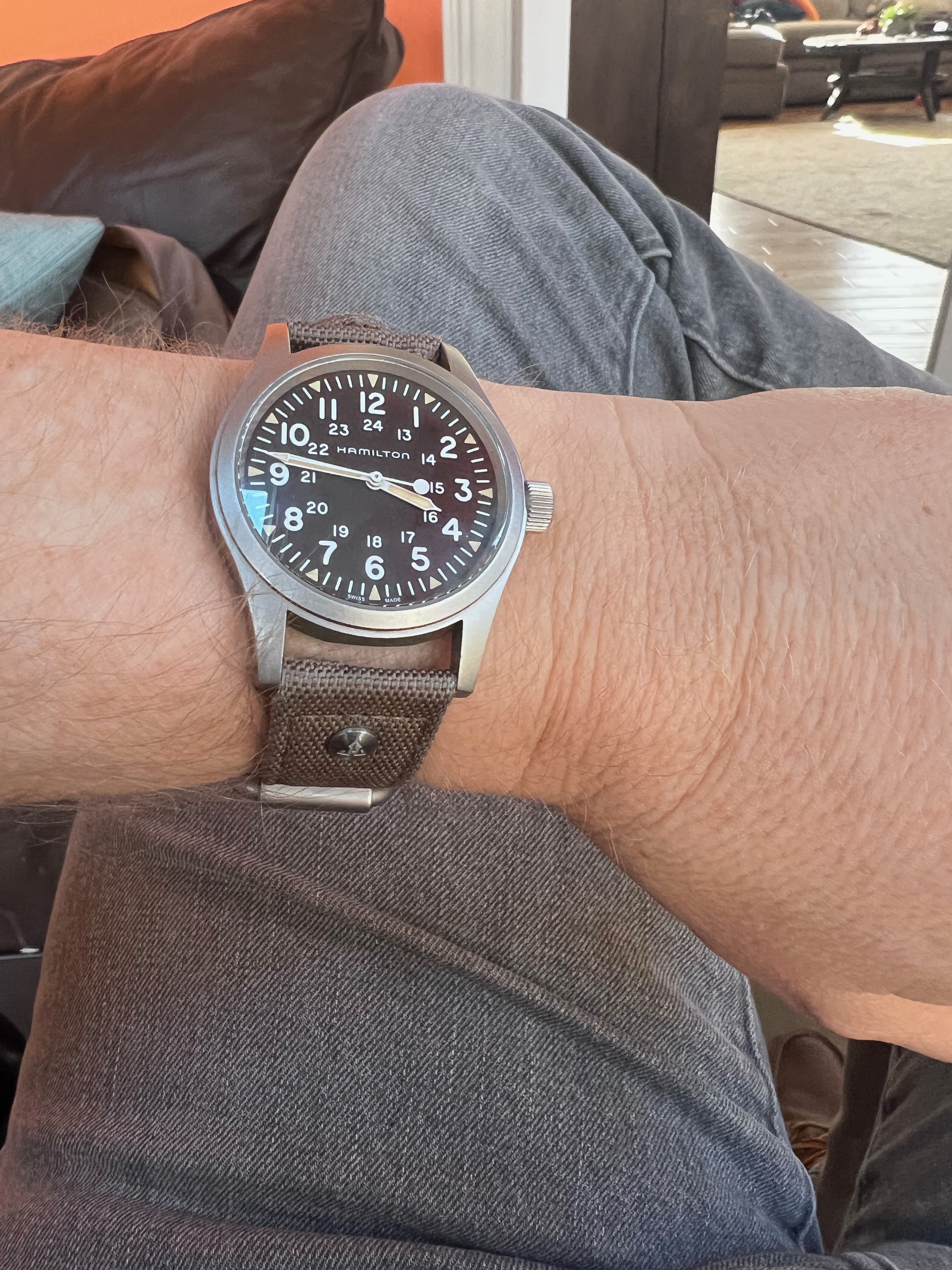
I've come around to the field watch aesthetic. There's an honesty to it. No pretension, no unnecessary complications. A clean dial, legible numerals, a sensible case size, a durable strap. It descends from watches built for soldiers who needed to read the time quickly and reliably under bad conditions. Form follows function in the most literal way.
Lately I've been looking at Citizen Eco-Drive field watches — something I would have scrolled right past a few years ago. A solar-powered quartz movement in a modest case with a day-date display and a canvas strap. No exhibition caseback. No sweeping seconds hand. Nothing to admire, in the way I used to define that word. But everything to use.
What I'm Actually Saying
I lost my job last year. A good one, well-paying, the kind you build a life around without thinking too hard about it. Nine months of unemployment followed before I landed a contract position — less pay, less certainty, no guarantee of what comes next. AI is reshaping the landscape for people like me in ways that aren't fully visible yet but are easy enough to feel. The ground shifted, and it hasn't stopped shifting.
I don't think it's a coincidence that my taste in watches shifted too.
When things were comfortable, I spent without much thought. Another automatic, another steel bracelet, another complication I didn't need but liked the idea of owning. There was a peacock quality to it that I'm only seeing clearly now — a kind of status signaling that never really fit me but was easy to fall into when money wasn't a concern. You accumulate, you display, you tell yourself it's appreciation.
But when the floor drops out, you start noticing what actually holds weight and what was just decorative. Function starts to look different. Pragmatism stops feeling like a compromise and starts feeling like clarity. The things that work quietly and reliably and don't demand your attention — those start to look like virtues, not settling.
I still wind my watches. I still like the sweep of a mechanical seconds hand. I'm not converting — I'm just not excluding anymore.
But I think there's a version of watch enthusiasm — and maybe a version of living — that mistakes exclusivity for taste. That confuses the story you tell about what you own with the experience of owning it. The exhibition caseback is fascinating, but my wrist is in the way. The chronograph is impressive, but I don't use it. And the quartz watch I used to dismiss does everything I actually need, quietly and well and without asking for my attention or my maintenance or my money.
What I use is: the time. The day. The date. And I want those to be right.
I think my watch journey has been a slow walk toward honesty. I'll still wind a manual watch tomorrow morning and feel something real in the ritual. But a Citizen Eco-Drive on a nato strap will tell me it's Saturday, February 15th, and it'll be right, and I won't have thought about it once. There's room for both.